Max's Fresh Ideas to end inequality & unfairness

Education Freedom
Affordability Freedom Your dream home
Healthcare Freedom
From Segregation to ZIP-Code Segregation: an underprivileged child's future shouldn't depend on their address. Education monopoly must be broken so that parents are free to choose the school that best serves them.
Healthcare Freedom
Affordability Freedom Your dream home
Healthcare Freedom
Financial insecurity should not put lives at risk. We must put healthcare dollars directly in people's hands and cutout the middlemen. While encouraging employer provided insurance, we must have safety net for all citizens, who need it.
Affordability Freedom Your dream home
Affordability Freedom Your dream home
Affordability Freedom Your dream home
ZIP-code school segregation Is fueling the housing crisis. Good school districts tend to raise real-estate prices for all. Taxes on fuel and food further strain family budget. We are losing parks, and open spaces where we need them the most.
Insurance Freedom Home & Auto
Affordability Freedom Your dream home
Affordability Freedom Your dream home
From Redlining to Credit Scoring: a new barrier for the underprivileged. A low credit score doesn't make you a bad driver or a bad homeowner. It is unfair to people who are already struggling financially.
Major Policy Initiatives (mentioned above) - in detail
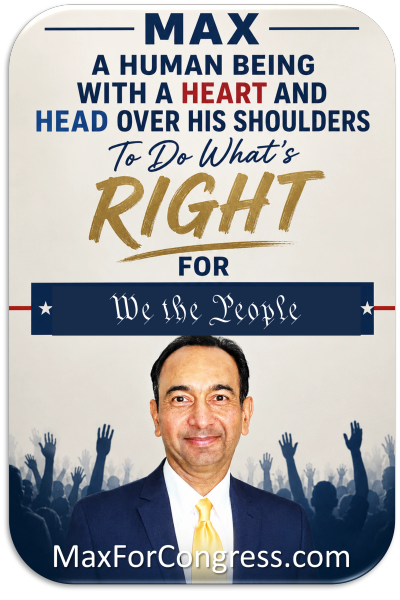
For too long, both political parties have failed many of the underprivileged and underserved communities in our district. Democrats often take these communities for granted as a reliable voting bloc, while Republicans too often fail to engage them in a meaningful way.
I am not your traditional Republican. I do not see people as Black, Brown, White, or any other label. I see fellow Americans. We all bleed red, and we all stand under the same flag—red, white, and blue. My major policy initiatives are simple and will benefit every American.
My commitment is simple: to advance policies that expand opportunity, strengthen families, and increase prosperity for every American, regardless of race, color, creed, or religion. I am running to represent all of We the People — not some of the people.
Education Freedom - End ZIP-Code SEGREGATION
I believe Americans must start thinking outside the box about the future of education. Racial segregation may have ended on paper through laws, but in many ways, it still exists through “zip-code segregation,” where children are trapped in failing school districts simply because of where they live.
Every American child deserves the freedom to access a quality education, regardless of income or ZIP code. I believe expanding school choice and privatizing education would create more opportunities for students by encouraging schools that cater to different talents, career paths, and learning styles instead of a one-size-fits-all system. Greater competition would improve educational outcomes while also stimulating economic growth across multiple industries. More schools would mean more jobs in construction, education, transportation, apparel, and food services. Parents — not government bureaucracies or lobbyists — should have the ultimate authority over their children’s education.
My vision for school choice includes:
- Ending “zip-code segregation” by allowing parents to choose schools that best fit their children’s needs.
- Funding students directly through school vouchers applied through parents' tax-return.
- Encouraging the growth of private and vocational schools to create diverse educational opportunities.
- Evaluating school performance through standardized testing and measurable academic outcomes.
- Protecting parents’ rights to make educational decisions for their children.
- Reducing special-interest and lobbyist control over America’s education system.
True school choice would empower parents, improve accountability, expand opportunity, and help ensure that every child has access to a quality education, not just those who can afford to live in the “right” ZIP code.
Your Healthcare - Your Way
My healthcare plan puts patients, not bureaucrats, in control by providing healthcare vouchers directly to citizens through the tax-filing process, ensuring the money is in the hands of the people. These vouchers would be used exclusively to purchase health insurance, giving individuals the freedom to choose customized plans that best meet their needs, while requiring catastrophic coverage as a minimum standard. Americans should be able to purchase insurance from anywhere in the country to increase competition and lower costs. Policies should be sold through licensed insurance agents, with severe penalties for fraud and abuse. Healthcare billing must also become transparent, with patients receiving the full bill clearly showing the portion paid by the patient and the portion covered by the insurance company.
In addition, all legal visitors and illegal immigrants should be required to carry health insurance from their home country, or their government should be held financially responsible for their medical expenses. This market-driven approach would help reduce the growing burden on Medicare, Medicaid, and other taxpayer-funded healthcare programs.
Employers, as they do today, would continue to be incentivized to provide health insurance to their employees, further reducing the burden on taxpayer-funded programs. This plan would especially benefit working families and those below the poverty line by giving them greater healthcare freedom and access to regular preventive care, helping detect problems early and avoid catastrophic medical events. At the same time, mandatory catastrophic coverage would provide a vital safety net against medical bankruptcy during major illnesses or emergencies. By putting patients first, increasing competition, and reducing government dependency, we can create a more affordable and transparent healthcare system. With the support of citizens, we can take on the healthcare lobbyists and return control of healthcare decisions to the American people.
Affordability Freedom
Being in the construction industry, I see firsthand how rising material, labor, and regulatory costs are driving up home prices, while high interest rates are making it harder for working Americans to achieve the financial independence that comes with the American Dream of homeownership. Another major challenge is “zip code segregation” for schools, where families are effectively priced out of desirable school districts because home values are tied to access to better-performing schools.
At the same time, large corporations should not be allowed to buy up single-family homes and convert them into rental properties, because it artificially drives up prices and pushes real families out of the market. To restore affordability and encourage long-term investment in communities, I believe we should:
- Reduce unnecessary regulations and costs that inflate home construction prices.
- Promote policies that increase housing supply and homeownership opportunities.
- Address “zip code segregation” that locks families out of quality schools through inflated housing markets.
- Prevent corporations from purchasing single-family homes for rental portfolios.
- Eliminate capital gains taxes on long-term real-estate appreciation to help families build generational wealth.
- Reduce mortgage interest rate for low-income families.
- Eliminate taxes on energy and food to bring down costs of living.
Insurance Freedom
Yesterday's red lines were drawn on maps. Todays are drawn through credit scores. In both cases, the people who can least afford it end up paying the highest price.
For decades, many minority and low-income communities suffered under the practice of redlining, where insurers and lenders either denied services or charged higher rates based largely on where people lived. The practice was widely condemned because it unfairly penalized entire neighborhoods and limited economic opportunity for generations.
While formal redlining has largely disappeared, many critics argue that credit-based insurance scoring has become a modern substitute. Instead of using ZIP codes or neighborhood maps, insurers rely on credit scores that are often influenced by income, wealth, access to credit, medical debt, and financial setbacks. The result can be strikingly similar: poorer communities and minority households frequently end up paying higher insurance premiums regardless of whether they are actually riskier drivers or homeowners.
A low credit score does not cause car accidents. It does not make a roof more likely to leak. It does not make someone irresponsible or dishonest. Yet people with lower credit scores can pay hundreds or even thousands of dollars more for the same insurance coverage than someone with a higher score and an otherwise similar risk profile.
This creates a troubling cycle. Families facing financial hardship are charged more precisely because they are struggling financially. Higher premiums leave them with less money to save, invest, improve their homes, or pay down debt—making it even harder to improve their financial standing. Rather than helping people climb the economic ladder, the system can pull the ladder farther away.
America rejected redlining because we recognized that people should be judged as individuals, not by broad economic or demographic characteristics. Insurance should return to that principle. Rates should be based on actual risk factors—driving records, claims history, property conditions, and personal responsibility—not financial circumstances that often reflect past hardship rather than future risk.
If we believe in economic mobility and equal opportunity, we should not replace one form of economic discrimination with another. Insurance should measure risk, not poverty.
My blueprint for our district’s peace & prosperity

Defend the U.S. Constitution
If you believe the U.S. Constitution is the supreme law of the land and must not be altered to accommodate foreign laws or ideologies incompatible with a civilized society, I’m your candidate. Common sense tells us freedoms shrink whenever and wherever Sharia and socialism are imposed.
Lower Taxes
If you believe working families should keep more of their hard-earned money, I’m your candidate. Common sense tells us higher taxes drive jobs and businesses away—leaving fewer opportunities and greater hardship behind.
- Tax-free at sixty-three - eliminate income taxes for individuals over 63, so seniors can enjoy their sunset years with dignity and financial security.
- Eliminate capital gains tax on the sale of a primary home, protecting the value-appreciation of their American Dream.
- Eliminate income taxes on export earnings for small businesses, empowering American entrepreneurs to compete and thrive in global markets.
Affordable Living
Everything has gone up in prices - except our paychecks :( If you believe we need to be realistic about affordability of consumer goods for everyday Americans, I’m your candidate. Prices that surged during COVID were because of supply chain disruptions and rising energy costs, yet even as energy prices have returned to pre-pandemic levels, everyday goods remain expensive, continuing to strain American families. Tariffs imposed by the current administration may have raised government revenue and signaled toughness to global trade partners, but in practice they function as taxes on American importers and consumers, driving up the cost of goods at home.
Update: Tariffs raised prices for American consumers. Now that the courts have invalidated those tariffs, refunds are going to importers—not consumers. That's fundamentally unfair: consumers paid the price, but importers got the money back.
Diplomacy First. Strength Always.
If you believe America should prioritize diplomacy to resolve conflicts and trade disputes, I’m your candidate. Military force must always remain an option — but only as a last resort. Our goal should be to protect American lives, avoid unnecessary entanglements, and use force only when there is a clear mission and a clear exit strategy.
Common sense tells us that American blood, resources, and resolve should be committed only when our national interests are clear and the path forward is defined.
The same principle applies to trade policy. Tariffs may sound tough, but when poorly designed they often function as taxes on American consumers through higher prices. Before imposing policies that disrupt markets and raise costs, our leaders must carefully consider the consequences for hardworking American families. Diplomacy and negotiation should be our first tools for resolving trade disputes, with economic penalties used strategically and only when the benefits clearly outweigh the costs to the American people.
Law & Order
If you believe safe district is essential for residents, businesses, and tourism in NC-04, I’m your candidate. Common sense tells us no one wants to live or invest in unsafe, no-go zones, and sanctuary cities. Crime hurts families, jobs, and our economy. From the U.S. Armed Forces to local first responders, those who keep us safe deserve our respect and support. Service earned it, America owes it, and I will leave no veteran behind.
Safety for Women and Girls
If you believe our daughters and women deserve privacy, dignity, and safety in sports and private spaces, I’m your candidate. Common sense tells us God made us who we are, we should cherish that gift. Also, women in domestic violence situations and suffering from Battered Woman Syndrome must be rescued. Click here to see the teaser of a feature film we are producing to bring awareness to Battered Woman Syndrome and domestic violence.
Legal. Merit-Based. Assimilated.
As an immigrant myself, I believe in common-sense immigration. I believe that U.S. Citizenship is an honor & must be earned. If you want immigration based on merit, the rule of law, and assimilation, I am your candidate. Common sense tells us that a shared language (English) and respect for American values unite us as one nation.
Seasonal Workers: Legal, Orderly, Fair
If you believe American farmers, construction, and hospitality industries need access to seasonal workers, and that there should be a legal, orderly way to hire them when needed — I’m your candidate. Common sense tells us a Labor Exchange system can be a win-win for all. By vetting seasonal workers through U.S. embassies, businesses can fill temporary labor needs legally, temp-immigrant workers are protected from exploitation, and participants return to their home countries once the work is complete. This approach strengthens key industries, respects the rule of law, and brings fairness and transparency to the system.
Freedom to Build & Innovate
If you believe entrepreneurs deserve fewer regulations and lower barriers to start and grow businesses, I’m your candidate. Common sense tells us excessive regulations protect big crony corporations — not small competitors.
American Tax Dollars for Americans
If you believe American tax dollars should be spent here at home — benefiting American citizens — I’m your candidate. Common sense tells us too much foreign aid never reaches the people it’s meant to help. Helping Americans succeed means restoring independence and dignity, not fostering dependency.
Free and Fair Trade
If you believe America should trade with countries that respect human rights and treat American products fairly, I’m your candidate. Free and fair trade strengthens our economy, supports American workers, and keeps prices affordable for families. Common sense tells us that excessive tariffs and protectionism often raise costs for consumers and small businesses the most. Also, excessive pressure on trade partners and allies can backfire, pushing them toward our adversaries and ultimately harming U.S. economic and national security interests. Strong trade policy does not have to mean blunt force. Recent tensions with strategic partners like India show why diplomacy matters.
Limited Government
If you want smaller, limited government, I am your candidate. Lawlessness and corruption lead to bloated government. Businesses and residents leave to stretch their dollars elsewhere, while those left behind pay the price. Common sense tells us smaller, accountable governments work better for everyone.
The federal leviathan must end baseline budgeting and return to true, need-based budgeting that justifies every dollar spent. Agencies should prepare and submit their budgets to Congress at least six months before the end of the fiscal year, allowing proper review, transparency, and accountability. Responsible planning will reduce last-minute brinkmanship and help eliminate the constant reliance on Continuing Resolutions, which too often become political bargaining chips that leave the nation in a financially fragile position.

Constitutional Carry from sea to shining sea
America’s gun violence stems from moral decline and a growing mental-health crisis. Common sense tells us when criminals and unstable individuals are armed, law-abiding citizens must have the right to protect themselves — without unnecessary restrictions.
Term Limits & No Personal Enrichment
Power is addictive. Politicians rarely give it up willingly—that’s why We the People must set limits.
- Term Limits: 6 terms in the House, 2 terms in the Senate
- No Stock Trading: Members of Congress shouldn’t profit from inside access
- No Pay-to-Play Deals: Public office is not a path to personal wealth
Elected officials should serve the public, not themselves. Period.
Right to Life & Preventing Abortion
This is a deeply personal and painful issue that deserves compassion, humility, and respect for life and individual circumstances. My faith discourages abortion, and personally I do not support it; however, in tragic cases such as rape, incest, or when a mother’s life is at risk, I believe these decisions should remain within the family, guided by medical professionals.
Gender Ideology

Let kids be kids
The picture on the left is my youngest son at 4 years old. He watched his sister dress up in different outfits while everyone called her cute. One day, he asked me, “Why am I not a girl?”
I asked him why he would want to be one. His answer was simple and innocent: because his sister got to wear all kinds of stylish clothes, while all he ever wore were “shorts and t-shirts.” He repeated “shorts and t-shirts” three times just to make sure I understood how bored he was with them.
Instead of acting like a foolish parent (or a deranged adult) and believing my son somehow wanted to become a girl, I understood what was really happening — a child being a child. So, I played along and told him to wear his shorts through one leg opening like a skirt. He laughed, loved the idea, and moved on with life.
Today, at 21 years old, he is chasing girls (metaphorically speaking).
The moral of the story: let kids be kids. Every child goes through phases, curiosities, and moments of imagination. Most of us (not all) grow wiser and more grounded as we mature. But when society pushes children (or supports physically grown-ups) against the natural grain of life, the result is often confusion, anger, frustration, sadness, and unhappiness.
God does not make mistakes. He made us in His image. He has given us almost everything we need in life — except one thing: satisfaction. That is something each of us must find for ourselves.
Once you find satisfaction, life becomes blissful.